 ultimate-guide
Locksmith 12 Month Guarantee Coverage Explained (2026)
Table of Contents
- What a Locksmith 12 Month Guarantee Actually Covers
- The Locksmith Workmanship Guarantee and What It Means for You
- Consumer Rights Act 2015: How It Backs Locksmith Services
- What to Look for in a Locksmith Quote Before You Book
- Exclusions and Voiding Conditions You Need to Know
- How to Claim Under a Locksmith Guarantee
- Why Documentation and Professional Installation Matter
- Frequently Asked Questions
Last Updated: September 12, 2026
What a Locksmith 12 Month Guarantee Actually Covers
A locksmith 12 month guarantee coverage explained in plain terms means this: if a part supplied by the locksmith fails because of a defect, it gets replaced at no cost to you within twelve months, and that is the locksmith 12 month guarantee coverage explained in full. That is the promise in its simplest form. At AE Locks, every part we fit carries a 12-month guarantee, and understanding what sits inside and outside that promise saves you an argument later.
The guarantee is not a blanket insurance policy on your door. It covers the parts a locksmith supplies and fits, nothing more.
Crucially, it does not cover your whole door, your existing hardware, or damage you cause after the job. Most disputes arise because homeowners assume "guarantee" means everything is protected forever. It does not.
GOV.UK guidance on consumer rights when buying services
Parts vs Workmanship: Two Sides of the Same Guarantee
Parts cover is the physical component: a euro cylinder, a mortice lock, a set of keys, a handle. If that component fails mechanically within the guarantee period, the locksmith replaces it.
Workmanship cover is the labour and the quality of fitting. If a lock fails because it was installed badly, that is a workmanship issue, not a parts issue.
These two sit side by side in a good guarantee. A faulty component is replaced under parts cover. A poorly fitted lock is put right under workmanship cover. Ask any locksmith which one they are offering, because the answer changes what you can claim. AE Locks provides a 12-month guarantee on all parts.
The Locksmith Workmanship Guarantee and What It Means for You
A workmanship guarantee promises the installation itself was done to a professional standard. If the lock mechanism fails because of how it was fitted, the locksmith returns and corrects it. This is separate from the manufacturer warranty on the part. AE Locks provides a 12-month guarantee on all parts.
Here is the distinction that trips people up. The manufacturer warranty covers the product against manufacturing defects. The workmanship guarantee covers the fitting. A cylinder that jams because of a manufacturing fault is a manufacturer warranty claim. A cylinder that jams because it was fitted out of alignment is a workmanship claim.
A common mistake is assuming the two are interchangeable. They are not, and a locksmith who explains both clearly is one worth hiring. AE Locks provides a 12-month guarantee on all parts.
Consumer Rights Act 2015: How It Backs Locksmith Services
The Consumer Rights Act 2015 gives you statutory protection on services, and it sits underneath any guarantee a locksmith offers. Under the Act, services must be carried out with reasonable care and skill, within a reasonable time, and at a reasonable price where one was not agreed upfront.
This matters because your rights do not depend on a guarantee existing. Even without a written guarantee, the Act requires the work to be done properly. A guarantee adds a clear, time-bound remedy on top of those statutory rights.
Consumer Rights Act 2015 on legislation.gov.uk
If a locksmith's work falls below the standard required, you have a legal route to a remedy regardless of what their terms and conditions say. The guarantee simply makes the process faster and less adversarial.
What to Look for in a Locksmith Quote Before You Book
A trustworthy locksmith quote should state the parts being supplied, the labour involved, and the guarantee terms. Anything vague deserves a follow-up question. But the part most guides skip is what happens to the guarantee after the job is done, because a guarantee you cannot evidence is a guarantee you cannot enforce.
Use this checklist before you book:
- Is the price fixed and confirmed before work begins?
- Does the quote name the parts being fitted, including the security rating?
- Is the guarantee period stated in writing?
- Does the guarantee cover parts, or workmanship?
- Are call-out charges and emergency rates explained upfront?
- Is there a clear process for making a claim?
- Will you receive a written guarantee document, not just a verbal promise?
- Does the guarantee state whether it is transferable if you sell the property?
A fixed quote given over the phone, with no hidden fees added on arrival, is the standard to expect. If a quote changes dramatically once the locksmith is at your door, treat that as a warning sign.
Documenting the Guarantee: What to Keep
The single most common reason a valid claim fails is missing paperwork. Build a small file, physical or digital, and keep the following together:
- The original invoice or receipt, showing the date, the parts fitted, and the price paid.
- The written guarantee terms, including the period, what is covered, and any exclusions.
- The locksmith's business details, including a trading name and a contact method that is not a mobile number alone.
- Photographs of the fitted lock, taken on the day, showing the cylinder or mechanism in place.
- Any key codes or key blanks supplied, since some guarantees require the original keys to remain in use.
- A note of the fitment date, written on the invoice if it is not already there.
If you are a tenant, pass copies of these documents to your landlord or letting agent. If you are a landlord, keep them with the tenancy file. A guarantee that cannot be produced on request is treated as though it does not exist.
Is the Guarantee Transferable?
Most guides never mention this, but it matters at the point of sale. Some locksmith guarantees can pass to a new owner when a property changes hands, provided the paperwork transfers with it. Others are strictly personal to the original customer and end the moment the property is sold or the keys are handed to a tenant.
Ask the locksmith directly: is this guarantee transferable, and what do I need to hand over for it to remain valid? Get the answer in writing. If it is transferable, note it on the invoice and include the guarantee document in the information pack you give to a buyer or a new tenant. If it is not, budget for the possibility that a future owner will need to re-secure the locks at their own cost.
Exclusions and Voiding Conditions You Need to Know
Every guarantee has exclusions, and reading them protects you. Typical exclusions include wear and tear, accidental damage, tampering with the lock after fitting, and any work carried out by a third party. The detail is where claims are won or lost.
Wear and tear is the gradual decline of a lock through normal use. A mechanism that loosens after years of daily operation is wearing out, not failing. That is usually outside guarantee cover. A lock that jams within weeks of fitting, with no visible damage, is more likely to be treated as a defect or a workmanship issue.
Voiding conditions are actions that cancel the guarantee. The common ones are:
- Fitting your own replacement parts, or asking a different tradesperson to adjust the lock.
- Forcing a jammed lock with the wrong tool, which bends pins and damages the cylinder.
- Using the wrong key in a cylinder, which wears the pins and can shear the plug.
- Painting over, lubricating with the wrong product, or otherwise altering the mechanism after fitting.
- Removing the lock from the door for any reason without the locksmith's involvement.
- Failing to report a fault within a reasonable time of noticing it.
A guarantee is not a maintenance contract. It covers failure, not neglect. If a lock is stiff and you keep forcing it for months before calling, the failure is likely to be attributed to misuse rather than defect.
Insurance Compliance and Lock Ratings
Insurance compliance matters here, and it is the point most homeowners miss. Some home insurance policies require locks to meet a certain security rating, often a British Standard kitemark such as BS 3621 for mortice locks or BS EN 1303 for cylinders. If a lock is swapped for a lower-rated one, a claim on your policy could be refused, even if the locksmith's own guarantee is intact.
Keep the security rating of any replacement at or above the original. Ask the locksmith to note the rating on the invoice. If your insurer has specified a standard, tell the locksmith before work starts so the correct product is fitted first time. A guarantee that covers the part but leaves you non-compliant with your policy is not much comfort after a break-in.
What the Consumer Rights Act 2015 Adds
The Consumer Rights Act 2015 sits underneath any guarantee a locksmith offers. Under the Act, services must be carried out with reasonable care and skill, within a reasonable time, and at a reasonable price where one was not agreed upfront. That means your rights do not depend on a guarantee existing, even without a written guarantee, the work must be done properly.
Where a guarantee and the Act overlap, the guarantee usually provides the faster route: a defined period, a defined remedy, and a named person to contact. The Act provides the backstop when a guarantee is silent, expired, or disputed. Knowing both means you are never relying on a single line of protection.
Consumer Rights Act 2015 on legislation.gov.uk
How to Claim Under a Locksmith Guarantee
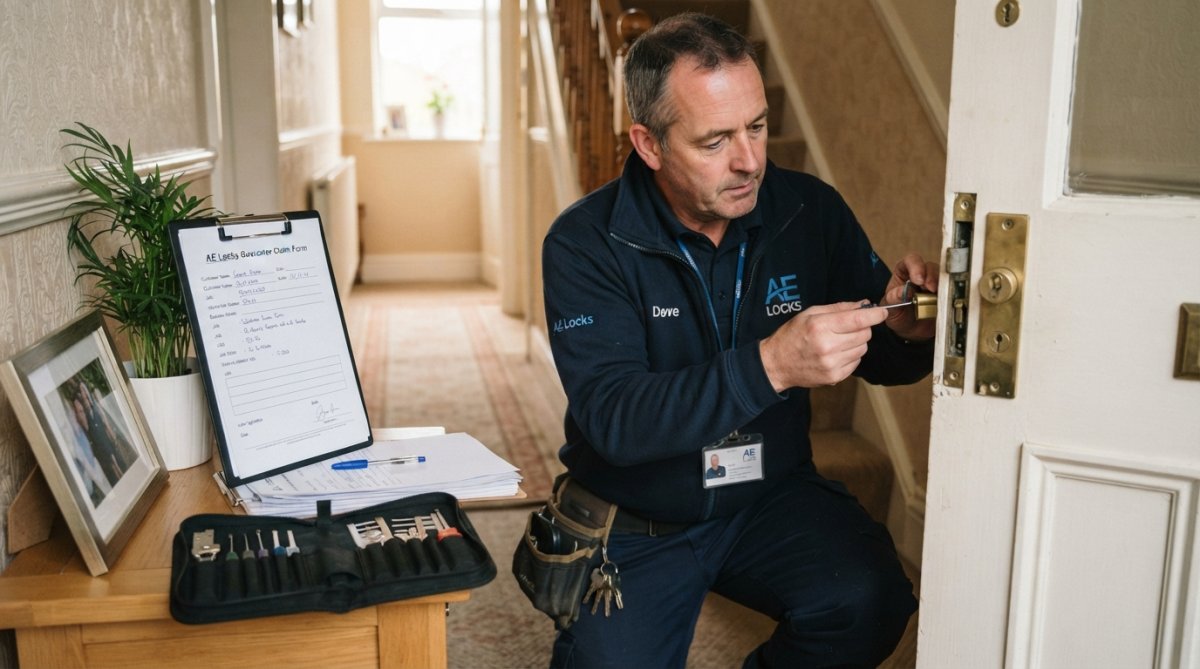
Making a claim is straightforward when you have kept your paperwork. The process usually follows a fixed sequence:
- Identify the fault. Confirm whether it is a parts failure or a fitting problem.
- Check the guarantee period. Confirm the fitment date and that you are still within twelve months.
- Gather your proof of purchase. A receipt or invoice showing the date and parts fitted.
- Contact the locksmith. Describe the fault and reference the original job.
- Arrange the inspection. The locksmith assesses whether the claim is valid.
- Get the remedy. A valid claim means a repair or replacement at no cost.
Documenting the guarantee is the step most people skip. Keep the invoice, note the fitment date, and store any written guarantee terms. Without proof of purchase, even a valid claim becomes a conversation about trust rather than fact.
Why Documentation and Professional Installation Matter
Professional installation is what makes a guarantee meaningful. A lock fitted correctly, with the door hardware aligned and the cylinder seated properly, performs as designed and rarely fails. A lock forced into a misaligned door fails early, and that failure is a workmanship problem.
DIY installation is where guarantees usually fall apart. Many guarantees are void if the part was not fitted by the locksmith who supplied it. Attempting a cylinder replacement yourself, then claiming a fault, rarely succeeds because the installation quality cannot be verified.
Two angles most guides miss deserve a mention. First, warranty transferability: some guarantees can pass to a new owner if you sell the property, but only if the paperwork transfers too. Ask whether yours is transferable. Second, emergency call-out fee coverage: AE Locks does not charge a call-out fee.
Royal Society for the Prevention of Accidents home safety guidance
Frequently Asked Questions
What is typically covered under a locksmith's 12-month guarantee?
A locksmith 12 month guarantee usually covers parts supplied and fitted by the locksmith. If a faulty component fails due to a manufacturing defect, the locksmith should repair or replace it at no extra cost. It does not cover damage caused by misuse, attempted break-ins, or general wear and tear over time. AE Locks provides a 12-month guarantee on all parts. Always check the written terms for the exact scope.
Does a locksmith guarantee cover lost keys or accidental damage?
No, standard guarantees exclude lost keys and accidental damage. If you lose your keys or damage the lock yourself, any repair or replacement is chargeable. Some providers offer a separate key replacement service, but this sits outside the 12-month guarantee. Keep your original keys safe and consider a spare set with a trusted neighbour to avoid unnecessary call-out charges.
What is the difference between a manufacturer warranty and a locksmith workmanship guarantee?
A manufacturer warranty covers defects in the lock mechanism itself, typically for 12 to 24 months. A locksmith workmanship guarantee covers how well the lock was installed. If a lock fails because it was fitted incorrectly, the workmanship guarantee applies. If it fails because of a manufacturing fault, the manufacturer warranty applies. AE Locks provides a 12-month guarantee on all parts. A reputable locksmith will help you identify which one is relevant and handle the claim.
Are labour costs included in a 12-month locksmith guarantee?
In most cases, yes. A comprehensive guarantee includes both parts and labour for any covered fault. This means you should not pay a second call-out fee or labour charge if the locksmith needs to return to fix a problem covered by the guarantee. AE Locks provides a 12-month guarantee on all parts and does not charge a call-out fee. Confirm this in writing before work begins, as some providers only cover parts and charge labour separately.
A guarantee is only as good as the locksmith standing behind it. AE Locks is a family-run, independent service offering a full 12-month guarantee on all parts, with fixed quotes provided over the phone, no call-out fee, and no VAT charged. Most requests are completed on the first visit, and we are available 24 hours a day, 365 days a year for emergencies. Get a free quote from AE Locks and lock in protection you can actually rely on.